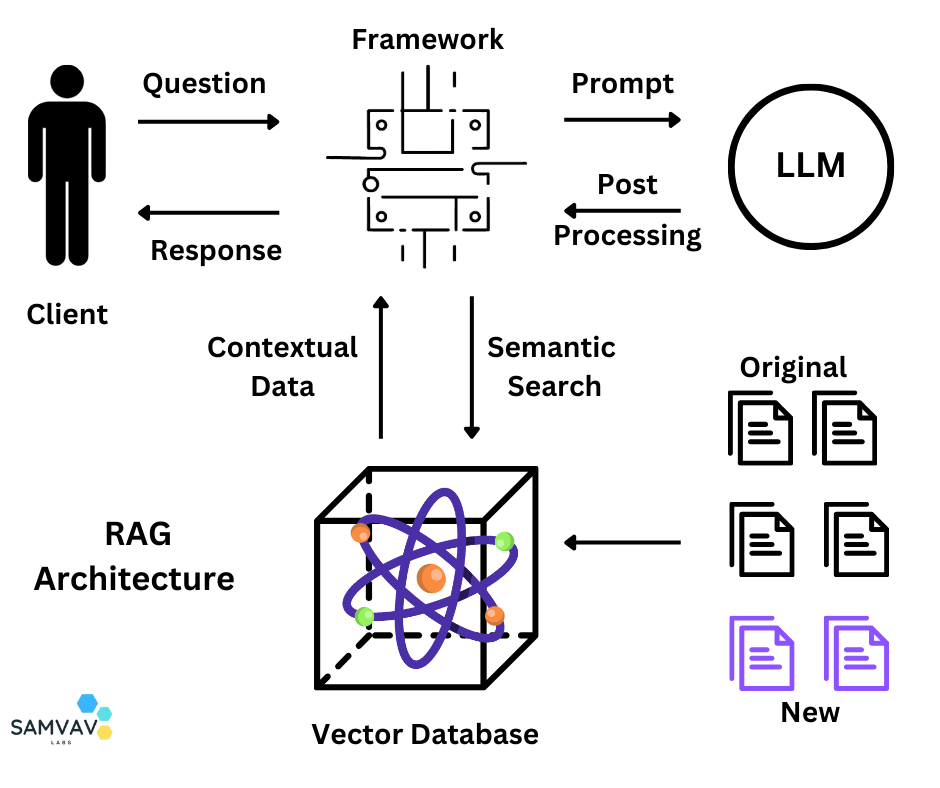
Artificial Intelligence (AI) is evolving rapidly, with new technologies and architectures emerging to enhance its capabilities. One such innovation is RAG, which stands for "Retrieval-Augmented Generation." This article explores what RAG is, its underlying architecture, the benefits it offers, and how it is poised to transform the AI landscape.
What is RAG?
RAG, or Retrieval-Augmented Generation, is an advanced AI framework that combines the strengths of two distinct AI techniques: retrieval-based models and generation-based models. The primary objective of RAG is to improve the accuracy and relevance of AI-generated content by leveraging a vast database of pre-existing information. This hybrid approach allows RAG to generate more informed, contextually appropriate, and precise outputs.
Architecture of RAG
The architecture of RAG integrates several key components:
- Retrieval Module: This component is responsible for fetching relevant information from a large dataset or knowledge base. It uses sophisticated search algorithms to identify and retrieve the most pertinent pieces of data that can inform and enhance the generation process.
- Generation Module: The generation module, often based on transformer models like GPT (Generative Pre-trained Transformer), takes the retrieved information and uses it to generate coherent and contextually relevant content. This module ensures that the final output is not only based on the input query but also enriched with factual and relevant data.
- Integration Layer: This layer seamlessly integrates the retrieval and generation modules. It ensures that the retrieved data is appropriately contextualized and formatted before being passed to the generation module, optimizing the overall process for accuracy and fluency.
- Feedback Loop: RAG systems often include a feedback mechanism that allows the model to learn from its outputs. By evaluating the performance and relevance of generated content, the system can continually refine its retrieval and generation processes.
Benefits of RAG
- Improved Accuracy: By combining retrieval and generation, RAG systems can provide more accurate and contextually relevant responses, significantly reducing the chances of generating incorrect or nonsensical outputs.
- Enhanced Relevance: The retrieval module ensures that the generated content is grounded in real, up-to-date information, making the outputs more relevant and useful for users.
- Scalability: RAG can be scaled to work with extensive datasets and knowledge bases, allowing it to handle a wide range of topics and queries effectively.
- Efficiency: The integration of retrieval and generation processes streamlines the workflow, enabling faster response times and more efficient content generation.
- Flexibility: RAG's modular architecture allows it to be adapted for various applications, from customer service chatbots to advanced research tools, making it a versatile addition to the AI toolkit.
How Will RAG Change the AI Landscape?
RAG is set to bring transformative changes to the AI landscape in several key ways:
- Enhanced User Experience: By providing more accurate and relevant responses, RAG can significantly improve user satisfaction and engagement in applications such as virtual assistants, customer support, and content generation.
- Advanced Knowledge Integration: RAG's ability to leverage vast knowledge bases means that AI systems can access and utilize a broader range of information, leading to more informed decision-making and insights across various industries.
- Innovation in Research: Researchers and developers can use RAG to create more sophisticated models and tools, pushing the boundaries of what is possible in AI. This can lead to breakthroughs in fields such as natural language processing, data analysis, and automated reasoning.
- Real-Time Applications: The efficiency and accuracy of RAG make it ideal for real-time applications, where timely and precise information is critical. This includes areas like real-time translation, live customer support, and interactive educational tools.
- Collaboration and Accessibility: RAG can facilitate greater collaboration between AI systems and human users by providing contextually enriched and reliable information. This makes advanced AI capabilities more accessible to non-experts, democratizing the use of AI across different sectors.
5 Use Cases of Retrieval-Augmented Generation (RAG)
- Customer Support and Service
- Application: Virtual Assistants and Chatbots
- Description: In customer support, RAG-powered chatbots can provide accurate and contextually relevant responses by retrieving information from a company’s knowledge base. When a customer queries the chatbot about a product issue or service detail, the retrieval module fetches the most pertinent information, and the generation module formulates a comprehensive and coherent response.
- Benefits:
- Increased Accuracy: Ensures responses are based on the latest and most relevant data.
- Enhanced Customer Satisfaction: Provides more precise and helpful answers, improving the overall customer experience.
- Efficiency: Reduces the time required to handle customer queries by providing instant, accurate responses.
- Healthcare and Medical Assistance
- Application: Clinical Decision Support Systems
- Description: RAG can be used in healthcare to assist doctors and medical professionals by providing detailed, evidence-based recommendations. For instance, when a doctor inputs a patient’s symptoms and history, the RAG system can retrieve relevant medical literature, case studies, and treatment guidelines, and generate a tailored recommendation.
- Benefits:
- Improved Decision-Making: Offers evidence-based recommendations, enhancing clinical decisions.
- Time Savings: Quickly accesses a vast amount of medical information, saving time for healthcare professionals.
- Enhanced Patient Care: Provides accurate and up-to-date medical advice, improving patient outcomes.
- Educational Tools and E-Learning
- Application: Intelligent Tutoring Systems
- Description: In education, RAG can be implemented in intelligent tutoring systems to provide personalized learning experiences. When a student asks a question or seeks help on a topic, the system can retrieve relevant educational content, such as textbooks, academic papers, and online resources, and generate a detailed and understandable explanation.
- Benefits:
- Personalized Learning: Tailors educational content to the needs of individual students.
- Comprehensive Explanations: Combines multiple sources to provide thorough and understandable answers.
- Engagement: Keeps students engaged with accurate and relevant learning material.
- Content Creation and Journalism
- Application: Automated News Generation
- Description: RAG can be utilized in journalism to generate news articles and reports. When provided with a topic or event, the retrieval module can gather relevant data from news databases, social media, and other sources. The generation module then uses this data to produce a coherent and factual news article.
- Benefits:
- Speed: Quickly produces news articles, ensuring timely reporting of events.
- Accuracy: Generates content based on verified and relevant information, reducing misinformation.
- Resource Efficiency: Allows journalists to focus on investigative work while automating routine news generation.
- Legal Research and Analysis
- Application: Legal Document Analysis
- Description: In the legal field, RAG can assist lawyers and legal researchers by providing detailed analyses of legal documents. When analyzing a case or preparing for a trial, the system can retrieve relevant laws, precedents, and case studies from legal databases, and generate a comprehensive analysis or summary.
- Benefits:
- In-depth Analysis: Provides thorough and detailed analyses based on extensive legal databases.
- Time Efficiency: Reduces the time spent on manual research by automating information retrieval and analysis.
- Accuracy: Ensures legal arguments and documents are based on accurate and relevant legal precedents and information.
Tags
RAG
AI
Retrieval-Augmented Generation
Data Science